



The examine of ship maneuvering at sea has lengthy been the central focus of the transport business. With the fast developments in distant management, communication applied sciences, and synthetic intelligence, the idea of Maritime Autonomous Floor Ships (MASS) has emerged as a promising resolution for autonomous marine navigation. This shift highlights the rising want for optimum management fashions for autonomous ship maneuvering.
Designing a management system for time-efficient ship maneuvering is likely one of the most tough challenges in autonomous ship management. Whereas many research have investigated this downside and proposed numerous management strategies, together with Mannequin Predictive Management (MPC), most have targeted on management in calm waters, which don’t characterize actual working circumstances.
At sea, ships are repeatedly affected by totally different exterior masses, with masses from sea waves being essentially the most important issue affecting maneuvering efficiency.


To deal with this hole, a workforce of researchers, led by Assistant Professor Daejeong Kim from the Division of Navigation Convergence Research on the Korea Maritime & Ocean College in South Korea, designed a novel time-optimal management technique for MASS. “Our management mannequin accounts for numerous forces that act on the ship, enabling MASS to navigate higher and observe targets in dynamic sea circumstances,” says Dr. Kim. Their examine was revealed in Ocean Engineering.
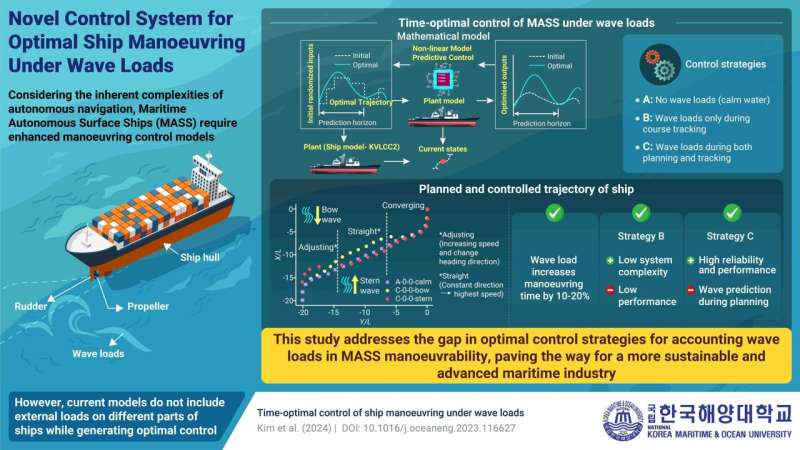
On the coronary heart of this progressive management system is a complete mathematical ship mannequin that accounts for numerous forces within the sea, together with wave masses, appearing on key components of a ship such because the hull, propellers, and rudders. Nonetheless, this mannequin can’t be immediately used to optimize the maneuvering time.
For this, the researchers developed a novel time optimization mannequin that transforms the mathematical mannequin from a temporal formulation to a spatial one. This efficiently optimizes the maneuvering time.
These two fashions had been built-in right into a nonlinear MPC controller to realize time-optimal management. They examined this controller by simulating an actual ship mannequin navigating within the sea with totally different wave masses.
Moreover, for efficient course planning and monitoring, researchers proposed three management methods: Technique A excluded wave masses throughout each the planning and monitoring levels, serving as a reference; Technique B included wave masses solely within the starting stage, and Technique C included wave masses in each levels, measuring their affect on each propulsion and steering.
Experiments revealed that wave masses elevated the anticipated maneuvering time on each methods B and C. Evaluating the 2 methods, the researchers discovered technique B to be easier with decrease efficiency than technique C, with the latter being extra dependable. Nonetheless, technique C locations a further burden on the controller by together with wave load prediction within the starting stage.
“Our technique enhances the effectivity and security of autonomous vessel operations and probably reduces transport prices and carbon emissions, benefiting numerous sectors of the economic system,” remarks Dr. Kim, highlighting the potential of this examine. “Total, our examine addresses a crucial hole in autonomous ship maneuvering which may contribute to the event of a extra technologically superior maritime business.”
Extra data:
Ming Zhang et al, Time-optimal management of ship manoeuvring underneath wave masses, Ocean Engineering (2024). DOI: 10.1016/j.oceaneng.2023.116627
Supplied by
Nationwide Korea Maritime and Ocean College
Quotation:
Researchers develop new management technique that optimizes autonomous ship navigation (2024, March 13)
retrieved 13 March 2024
from https://techxplore.com/information/2024-03-method-optimizes-autonomous-ship.html
This doc is topic to copyright. Aside from any truthful dealing for the aim of personal examine or analysis, no
half could also be reproduced with out the written permission. The content material is supplied for data functions solely.

